
September 21, 2026 · Axiom Scout Team
What a Real Site Evaluation Actually Looks Like
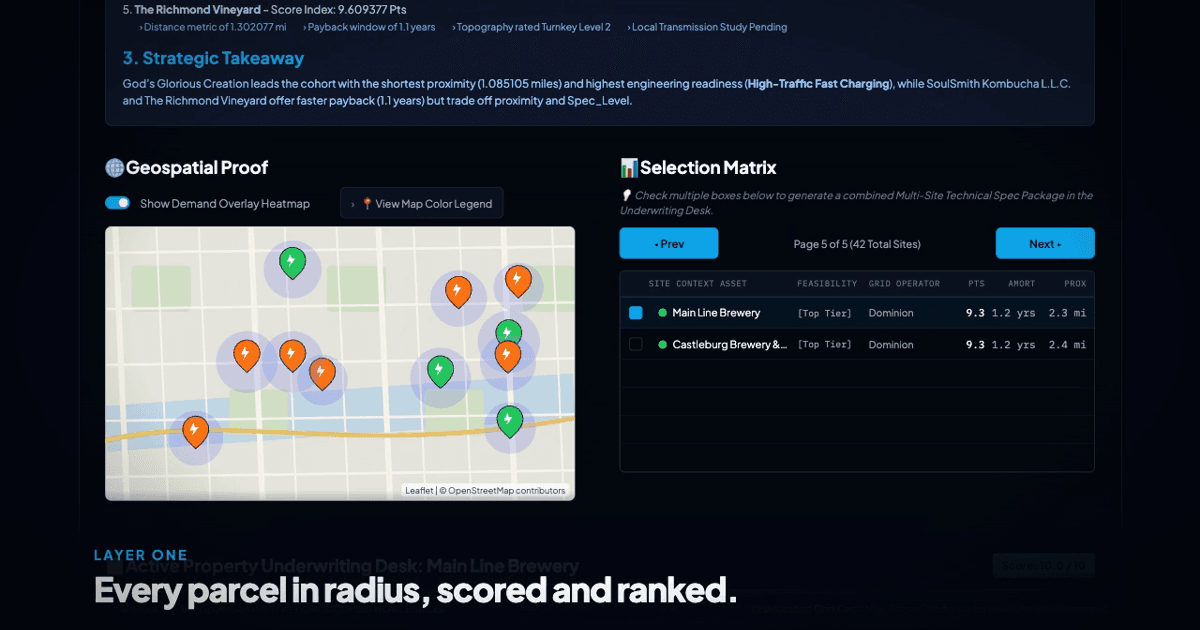
Most of what we publish here is about finding opportunity — a pocket of demand, a gap in the map. This one's different. A property owner reached out directly, asking whether their site could work for EV charging. Rather than treat it as a demo, we ran it through Axiom Scout exactly the way we'd want a real customer to — and we're publishing the honest result, including a mistake we caught and fixed along the way.
The site
A highway travel-stop property in the mid-Atlantic, owned by an operator looking to add EV charging with little to no upfront capital — the property would provide the space and access, and a charge point operator would fund, install, and run the equipment. That's a common, reasonable ask, and exactly the kind of decision our platform is built to inform.
The honest result
This one didn't come back as a top-tier candidate. The site sits outside any designated NEVI corridor, the build economics were real but not exceptional, and our confidence in the nearby grid capacity data was lower than we'd want before anyone breaks ground. None of that means the site is dead — plenty of good locations sit outside a funding corridor — but it does mean going into conversations with an operator clear-eyed instead of oversold.
We think that's the actual value of a tool like this. A site-evaluation platform that only ever tells you good news isn't evaluating anything — it's marketing. The useful version tells a property owner or a CPO exactly where a site stands, including when the answer is "proceed carefully" instead of "go."
The bug we found while doing it
Here's the part we could have quietly fixed and never mentioned. Early in this process, an initial read on the site came back looking confident — a named substation, a specific distance, a clean number — and it was wrong. Not wildly wrong in an obvious way; wrong in a plausible way, the kind that doesn't trigger any alarm because nothing about it looks broken.
The root cause turned out to be an address-matching edge case: when a location was passed in without a full city and state, our system could still return a confident-looking result instead of admitting it wasn't sure. That's arguably worse than returning no answer at all, since a wrong answer that looks right is exactly what a system like this exists to prevent.
A confident wrong answer is more dangerous than an honest "we're not sure."
We fixed it so that an incomplete location now fails safely — the system tells you it couldn't confidently locate the address, rather than guessing and presenting the guess as fact — and verified the fix against this exact case before calling it done.
Why we're telling you this
It would have been easy to only publish the wins. But a platform whose entire job is telling operators and property owners whether a site is worth pursuing only earns trust by being honest when the answer is mixed — and by owning it when something in the pipeline needs fixing, not just when it's convenient.
If you're a charge point operator evaluating sites, or a property owner trying to figure out whether yours is a fit, that's what we're actually offering — a straight answer, not a sales pitch.
Curious what an honest read on your own site would look like? Apply for beta access or see how it works for CPOs.